
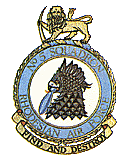
Rhodesian Air Force
No 5 Squadron
5 Sqn Gallery  Top of the page
Air Force Home Page
Site Home Page
Contact Us
Top of the page
Air Force Home Page
Site Home Page
Contact Us
Formation
No 5 Squadron was formed o the 13th April 1959.
Motto
"Find and Destroy"
Roles
The role of No 5 Squadron was that of bombing and photo
reconnaissance.
Squadron Commanders
Sqn Ldr John Mussell, 1962
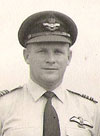 SqnLdr Keith Kemsley, 1963
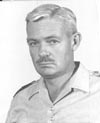 Sqn Ldr "Porky"
MacLaughlan, 1964
Sqn Ldr "Porky"
MacLaughlan, 1964
Sqn Ldr I.H. Donaldson, 1966 - 1967
Sqn Ldr D.J. Rogers, 1967 - 1968
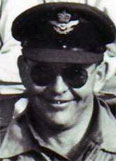 Sqn Ldr Peter Knoble, 1968 - 1970
Sqn Ldr E.H. Stevenson, 1970 - 1971
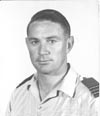 Sqn Ldr F.D. Janeke, 1971 - 1973
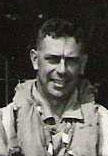 Sqn Ldr F. Du Rand, 1973 -1976
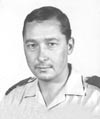 Sqn Ldr Chris Dixon, 1977 -1979
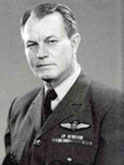 Sqn Ldr Ted Brent 1979 - 1981
History
1959
No 5 Squadron was originally formed as a Canberra squadron. It was originally based at New Sarum in the South side of Salisbury . It operated the English Electric Canberra (B2 and T4) aircraft until the withdrawl from service of the Canberra in 1983 the unit was disbanded.
1964
No 5 Sqn moved to New Sarum under command of Sqn Ldr “Porky” McLaughlan who took over from Keith Kemsley.
1967
July 1967 saw the introduction of 130 lb concrete practice bomb invented by Flt Lt Alan Cockle.
1969
In October 1969 during operation Irish Stew Air Lieutenant Jim Stagman and Flight Lieutenant Dave Postance ejected from their Camberra B2 aircraft and spent an uncomfortable night up trees in the Wankie National Park in order to avoid prowling lions. At dusk the aircraft entered a line of storm clouds and experienced repeated flame-outs and re-lights. Each of these meant descending to a lower altitude and then regaining altitude. During these emergencies they changed course several times and eventually became unsure of their position and ran out of fuel.
1971
During 1971 a Canberra was rebuilt from parts that had been placed in storage.
On 16th November 1971 a Canberra from No. 5 Squadron crashed in heavy rain near Salisbury killing Flight Lieutenant Alec Roughead and Air Lieutenant Guy Robertson. An investigation revealed that the aircraft crash was the result of the failure of Frame 21 due to metal fatigue. Frame 21 incorporates the main attachment point of the wings.
The problem of metal fatigue was know to and fully understood by the Air Force and the aircraft were monitored constantly. The aircrew were aware of this condition and most pilots handled the aircraft gently to avoid excessive fatigue on the Frame 21s.
1973
27th August 1973 Air Marshall Mick McLaren presented No. 5 Squadron with the Jacklin Trophy. (Third occasion)
1974
On the 4th April 1974 Canberra R2156 was lost killing the crew, Air Sub Lieutenant Keith Goddard (the pilot) and Air Sub Lieutenant Rich
Airey (the navigator) during a low level bombing attach north of the border in the Maconbe area.
The aircraft crashed following a large explosion in the immediate area of the bomb bay. The aircraft was
armed with 96 x 20 lb fragmentation bombs. It was presumed that one of the 20lb frag bombs had hit another that was armed and that this
resulted in a chain reaction.
1980
No 5 Squadron celebrated 21 years in service. (See the Photo Gallery for a picture of the Commemorative Plaque.
)Post Zimbabwe Independence
1986
No 5 Squadron was reformed in 1986 to operated the Chendu F-5 and F-7aircraft.
Two F-5 training aircraft were acquired in 1986 and these were used for conversion training until 1991.
1987
During 1987 twelve F-711 aircraft were acquired for the Squadron.
1991
Two FT-7BZ aircraft replaced the F-5s.
Top of page
Photo Gallery
Air Force Home Page
Site Home Page
Contact Us